
Across Africa, farmers work hard to produce food, yet many still struggle to reach reliable markets. The challenge is not always production. In many cases, the bigger challenge is what happens after production: aggregation, storage, quality control, logistics, pricing, processing, and access to serious buyers.
A farmer may have good produce but no structured buyer. A cooperative may have members ready to supply but no aggregation facility. A processor may need raw materials but cannot easily verify supply. A buyer may want quality produce but cannot trace where it came from. Financial institutions may want to support agricultural trade but lack reliable data.
This gap between production and market access is one of the biggest barriers to agricultural prosperity.
AgricTrail Trade Centres are being designed to close that gap.
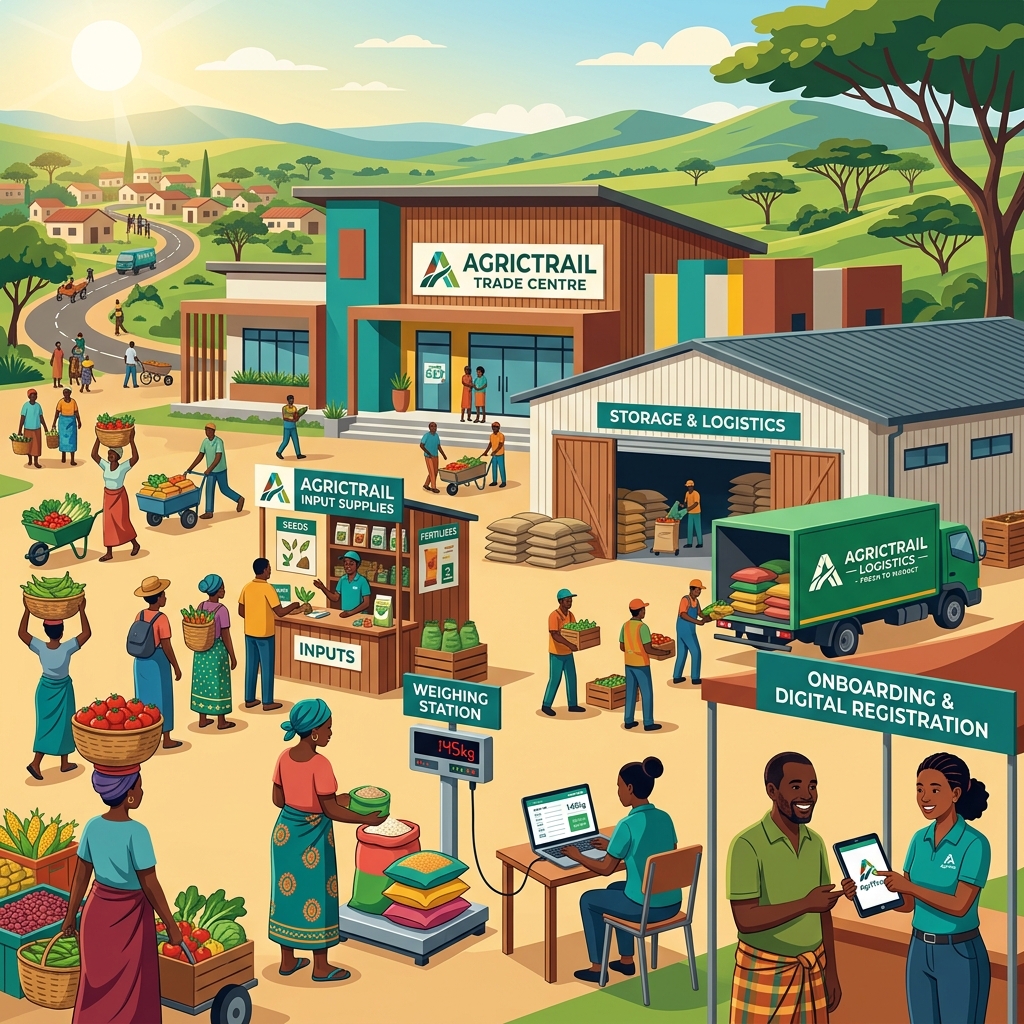
They will serve as physical-digital agricultural hubs that connect farmers, cooperatives, agribusinesses, processors, buyers, logistics providers, service providers, financial institutions, governments, NGOs, and consumers into a structured local market system.
The Market Access Problem
Many farmers do not lose income because they cannot farm. They lose income because the market system around them is weak.
Common challenges include poor pricing information, limited storage, high post-harvest losses, weak logistics, informal middlemen, lack of grading standards, limited buyer visibility, poor access to processing, and lack of trusted transaction records.
When farmers sell individually, they often have weak bargaining power. When buyers source from scattered farmers, they face inconsistent quality, unreliable volumes, and higher transaction costs.
This creates inefficiency for everyone.
Farmers earn less. Buyers struggle to source reliably. Processors face supply gaps. Consumers pay more. Financial institutions hesitate to fund agricultural trade because the system is not properly structured.
AgricTrail Trade Centres are built to bring structure into this process.
What Is an AgricTrail Trade Centre?
An AgricTrail Trade Centre is a local agricultural infrastructure hub designed to support the movement of farm produce from farmers to markets.
It combines physical facilities with AgricTrail's digital platform.
Each Trade Centre can support aggregation, storage, input access, produce grading, mini-processing, logistics coordination, market linkage, quality control, training, digital records, traceability, and financial services.
In simple terms, it is a place where farmers and cooperatives can bring produce, access services, connect to buyers, and participate in organized trade.
But it is more than a market.
It is a coordination centre for local agricultural value chains.
Connecting Farmers Through Cooperatives
AgricTrail's Trade Centre model is cooperative-led.
This is important because many farmers cannot access formal markets alone. But through cooperatives, farmers can aggregate produce, coordinate supply, meet buyer volume requirements, access training, and negotiate better terms.
The Trade Centre gives cooperatives a physical and digital point of coordination.
Farmers can be onboarded with AgricTrail ID, linked to their cooperatives, connected to FarmMate records, and supported through production, aggregation, and sales.
This creates a stronger pathway from individual farmer activity to cooperative-level market access.
From Farm Production to Market Transaction
The AgricTrail Trade Centre is designed to support the full journey of produce from farm to market.
The process begins with farmer onboarding and farm profiling. Farmers and cooperatives can record what they produce, where they produce it, and their expected supply capacity.
As production progresses, FarmMate helps capture farm activities, input usage, production records, and sales history. When produce is ready, farmers can bring it to the Trade Centre for aggregation, grading, storage, and market linkage.
Buyers, processors, exporters, retailers, and institutional purchasers can then source from a more structured supply system.
This helps reduce uncertainty.
Farmers know where to sell.
Buyers know where to source.
Cooperatives know what their members are producing.
AgricTrail knows how to connect production, logistics, finance, and market demand.
Aggregation and Storage
One major reason farmers lose value is the inability to aggregate and store produce properly.
When produce is sold immediately after harvest, farmers may be forced to accept low prices. When there is no storage, perishable produce may spoil. When produce is not aggregated, farmers may not meet the volume requirements of larger buyers.
AgricTrail Trade Centres will support aggregation and storage sections where farm produce can be collected, sorted, recorded, and prepared for sale or processing.
This helps farmers sell with better timing, better structure, and stronger market visibility.
It also helps buyers source larger quantities more efficiently.
Mini-Processing and Value Addition
Farmers often earn the least because they sell raw produce at the lowest point of the value chain.
AgricTrail Trade Centres will support mini-processing facilities where selected agricultural products can be cleaned, sorted, dried, milled, packaged, chilled, or transformed into higher-value products depending on the local value chain.
This creates opportunities for value addition close to the source of production.
Instead of moving only raw produce out of rural and peri-urban communities, Trade Centres can help create local jobs, reduce losses, improve product quality, and increase farmer income.
Value addition also makes it easier to supply processors, retailers, export markets, schools, hotels, supermarkets, and institutional buyers.
Input Access and Service Coordination
Market access begins before harvest.
Farmers need quality inputs, advisory support, mechanization, logistics, labour, water systems, veterinary services, equipment, and production planning. If these are not available, farmers may produce less, lose quality, or miss market windows.
AgricTrail Trade Centres will serve as access points for agricultural inputs and services.
Through AgricTrail's platform, farmers and cooperatives can connect with verified input suppliers, service providers, logistics partners, mechanization providers, extension workers, and finance partners.
This helps farmers prepare better for production and produce in line with market demand.
Quality Control and Traceability
Modern markets increasingly require proof of quality, origin, and compliance.
Buyers want to know where produce came from. Processors want consistency. Exporters need documentation. Consumers want trust. Governments and development partners need accountability.
AgricTrail Trade Centres will support quality control and traceability by linking produce to farmer identity, cooperative records, farm location, production history, aggregation records, and transaction data.
This helps create a trusted chain from farm to buyer.
Over time, this can support local trade, institutional procurement, export readiness, food safety, ESG reporting, and compliance with market standards.
Logistics and Distribution
A major weakness in agricultural markets is logistics.
Farmers may produce in one location while buyers are in another. Produce may be available but not moved on time. Transport costs may be too high. Cold chain may be unavailable. Delivery coordination may be poor.
AgricTrail Trade Centres will help coordinate logistics between farmers, cooperatives, aggregators, processors, retailers, exporters, and consumers.
By organizing supply at the Trade Centre level, logistics becomes easier to plan. Vehicles can move fuller loads. Buyers can pick up from structured locations. Perishable products can be handled with better timing. Delivery records can be captured digitally.
This reduces waste and improves efficiency.
Digital Market Linkage
The physical Trade Centre will be connected to AgricTrail's digital marketplace and trade infrastructure.
This means produce available at the Trade Centre can be visible to approved buyers, processors, agribusinesses, cooperatives, and institutional markets. Buyers can express demand. Cooperatives can list available supply. Trade records can be captured. Payments and settlement processes can become more transparent.
This creates a stronger bridge between local production and wider markets.
A farmer in a local community should not be invisible simply because the buyer is in another city, region, or country.
AgricTrail's digital layer helps make local supply visible beyond the local market.
Supporting Finance Through Trade Data
Trade Centres will also help unlock agricultural finance.
When produce is aggregated, recorded, stored, graded, and sold through structured channels, the data becomes useful for financial institutions. It can show production capacity, sales history, cooperative performance, buyer relationships, inventory movement, repayment potential, and trade reliability.
This can support input credit, working capital, warehouse receipt finance, cooperative lending, insurance, and offtake-linked finance.
In this way, Trade Centres do not only connect farmers to markets. They also help connect farmers and cooperatives to finance.
Creating Local Economic Hubs
AgricTrail Trade Centres are not only about buying and selling produce. They are designed to become local economic hubs.
Each Trade Centre can support jobs in aggregation, storage, processing, logistics, quality control, administration, extension, input distribution, equipment services, data collection, maintenance, and trade facilitation.
This can create opportunities for youth, women, cooperatives, service providers, and local entrepreneurs.
When properly developed, Trade Centres can help local communities retain more agricultural value instead of losing it to distant, unstructured markets.
A Model That Can Scale Across Local Government Areas
AgricTrail's Trade Centre model is designed to be replicable across Local Government Areas and agricultural clusters.
Each location can be adapted to its dominant value chains, farmer population, cooperative structure, production capacity, and market opportunities.
One area may focus on aquaculture, vegetables, poultry, and cassava. Another may focus on grains, livestock, cocoa, oil palm, or horticulture. The model is flexible enough to support different agricultural ecosystems while maintaining a common digital infrastructure.
This makes it possible to build a network of connected Trade Centres across Nigeria and eventually across Africa.
The Future of Market Access
The future of agricultural market access in Africa will not depend only on online marketplaces. It will require the integration of digital systems with physical infrastructure.
Farmers need places to aggregate.
Buyers need reliable supply points.
Processors need quality raw materials.
Financial institutions need data.
Governments need visibility.
Consumers need trust.
AgricTrail Trade Centres are designed to bring these needs together.
They will connect the farmer's production activity to the cooperative, the cooperative to the Trade Centre, the Trade Centre to buyers, buyers to finance, and the entire system to data, traceability, and impact intelligence.
Conclusion
AgricTrail Trade Centres will connect farmers to markets by solving the practical problems that stand between production and income.
They will support aggregation, storage, processing, logistics, quality control, traceability, digital trade, finance access, and cooperative coordination.
They will help farmers move from scattered selling to structured market participation.
They will help buyers move from uncertain sourcing to verified supply.
They will help cooperatives become stronger economic platforms.
They will help communities turn agricultural activity into local prosperity.
AgricTrail is building this model because African farmers do not only need to produce more. They need better systems that help them sell better, earn better, and grow sustainably.
AgricTrail — Connect. Grow. Sustain.