
African agriculture has enormous potential to feed the continent, supply industries, create jobs, support exports, and strengthen rural economies. Yet one major barrier continues to limit the value farmers and agribusinesses can capture from food trade: lack of trusted traceability.
In many value chains, produce moves from farmers to aggregators, traders, processors, transporters, wholesalers, retailers, and consumers without a clear digital record of where it came from, how it was handled, who was involved, and whether quality standards were followed.
This creates problems for everyone.
Farmers lose value because their produce is often treated as anonymous. Buyers face uncertainty because they cannot always verify supply origin or quality. Processors struggle with inconsistent documentation. Exporters face compliance challenges. Consumers have limited visibility into what they buy. Governments and development partners find it difficult to monitor food systems accurately.
Digital traceability can change this.
It can help African food trade become more transparent, trusted, organized, and competitive.
What Is Digital Traceability?
Digital traceability is the ability to track agricultural products through the value chain using digital records.
It connects produce to important information such as farmer identity, farm location, cooperative membership, production records, harvest data, aggregation point, storage facility, processing activity, logistics movement, quality checks, certification status, buyer transaction, and final market destination.
In simple terms, traceability answers key questions:
Where did this product come from?
Who produced it?
How was it handled?
Which cooperative or aggregator supplied it?
Was it processed, stored, or transported properly?
Can the transaction be verified?
Can the product meet market or export requirements?
When these answers are captured digitally, food trade becomes more trustworthy.
Why Traceability Matters for African Food Trade
African food trade often suffers from fragmentation.
Farmers produce in scattered locations. Aggregators collect from multiple sources. Produce changes hands several times. Records may be kept on paper, WhatsApp, verbal agreements, or not recorded at all.
This makes it difficult to prove quality, origin, volume, handling, and compliance.
As markets become more formal and buyers demand stronger documentation, traceability becomes increasingly important. Local supermarkets, processors, institutional buyers, exporters, financial institutions, and international markets all need reliable information.
Without traceability, African producers may struggle to access premium markets.
With traceability, they can build trust and compete better.
From Anonymous Produce to Verified Supply
One of the biggest weaknesses in food trade is that produce often becomes anonymous once it leaves the farm.
When produce is mixed without records, farmers who produce good quality may not be recognized. Buyers may not know which farms supplied a product. Cooperatives may struggle to reward reliable members. Exporters may lack the documentation required to prove origin.
Digital traceability helps preserve the identity of produce.
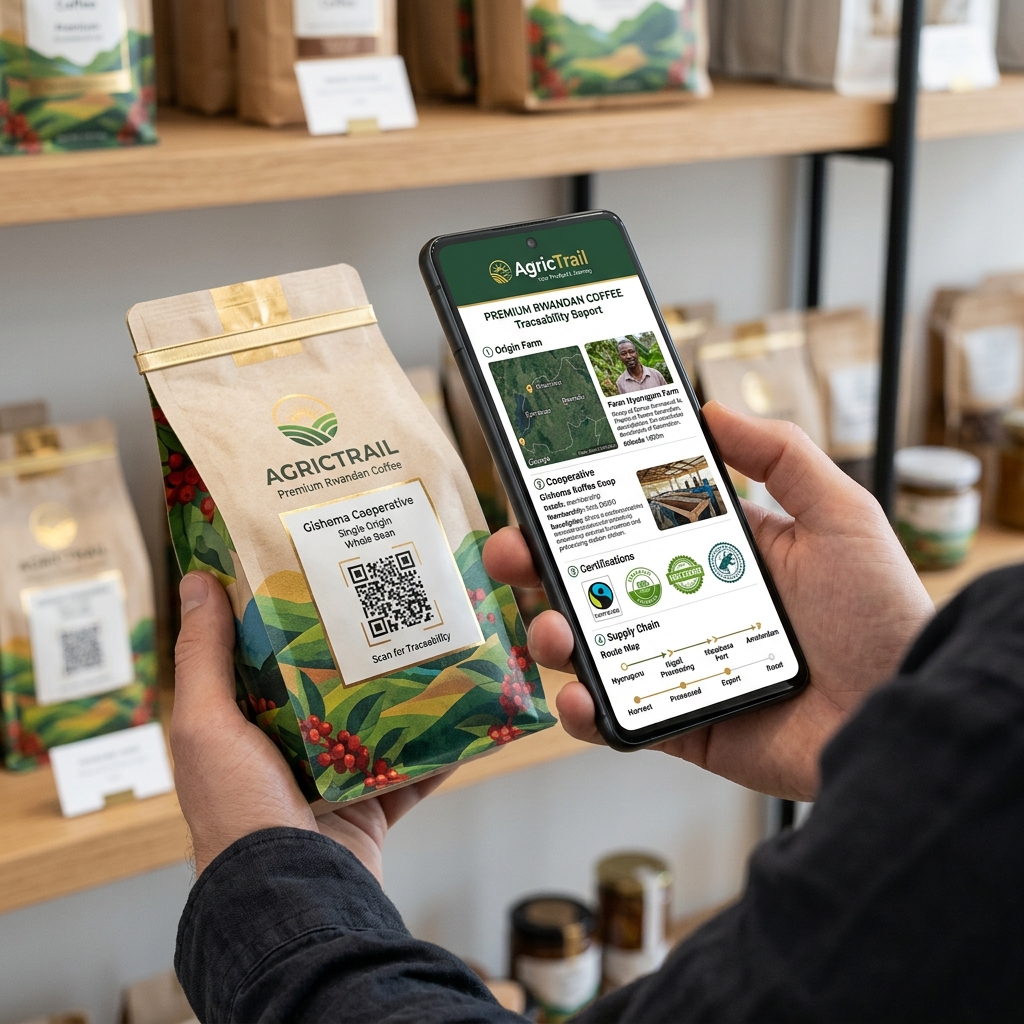
A bag of cocoa, a crate of tomatoes, a batch of fish, a sack of cassava, or a carton of processed food can be linked to the farmer, cooperative, aggregation centre, storage point, processing line, and buyer.
This allows quality and responsibility to be tracked across the value chain.
It also helps farmers and cooperatives build reputation over time.
Building Trust Between Farmers and Buyers
Trust is essential in food trade.
Farmers want fair prices. Buyers want reliable supply. Processors want consistent quality. Exporters want compliance. Consumers want safe food.
Digital traceability creates a shared evidence layer that supports trust.
When buyers can see where produce came from, how it was aggregated, whether quality checks were done, and which cooperative supplied it, they can make better purchasing decisions.
When farmers and cooperatives can show verified production and supply records, they can negotiate from a stronger position.
This reduces uncertainty and improves confidence on both sides of the market.
Improving Food Safety and Quality Control
Food safety is one of the most important reasons for traceability.
When products move through the supply chain without records, it becomes difficult to identify where contamination, spoilage, poor handling, or quality failure occurred.
Digital traceability helps create accountability.
If a product has a quality issue, records can show the batch, supplier, aggregation point, storage location, transport route, and processing stage involved. This makes it easier to respond quickly, correct problems, and protect consumers.
Traceability also supports better quality control by helping farmers, cooperatives, processors, and buyers track standards over time.
This can improve grading, sorting, handling, packaging, storage, and processing practices.
Supporting Export Readiness
For African agribusinesses, traceability is becoming increasingly important for export markets.
Many international buyers require documentation showing product origin, production practices, quality standards, sustainability compliance, and supply chain integrity. Without this documentation, exporters may lose access to valuable markets or be forced to sell at lower prices.
Digital traceability can help African producers and exporters prepare for these requirements.
It can support farm mapping, batch records, certification evidence, chain-of-custody tracking, quality testing, and export documentation.
This is especially important for commodities such as cocoa, coffee, palm oil, sesame, cashew, shea, fish, fruits, vegetables, spices, timber-related products, and other agricultural exports.
By making compliance easier to prove, traceability can help African food businesses compete in higher-value markets.
Reducing Post-Harvest Losses
Traceability is not only about compliance. It can also help reduce waste.
When produce is tracked from farm to market, it becomes easier to identify where losses happen. Losses may occur during harvesting, aggregation, poor storage, delayed transport, poor packaging, temperature failure, or market rejection.
Digital records can reveal patterns.
If a certain route causes delays, it can be improved. If a storage point has repeated spoilage, it can be investigated. If a crop is frequently rejected due to quality, farmers can receive better advisory support. If cold storage is needed, investment can be better targeted.
Traceability turns supply chain problems into visible data.
What is visible can be managed.
Helping Farmers Capture More Value
Farmers often lose value because the market cannot differentiate between verified and unverified produce.
Digital traceability can help farmers and cooperatives prove quality, origin, consistency, and reliability. This can support better pricing, stronger buyer relationships, access to formal markets, and participation in premium value chains.
A farmer who follows good practices should not be treated the same as an unknown supplier with no records.
A cooperative that can prove member production and aggregation should have stronger negotiating power.
Traceability helps convert good farming practice into market value.
Strengthening Cooperatives and Aggregation
Cooperatives play a central role in traceability.
Many farmers cannot meet buyer or exporter requirements alone. But through cooperatives, farmers can be onboarded, verified, trained, aggregated, and linked to structured markets.
Digital traceability helps cooperatives manage member records, farm profiles, production data, aggregation volumes, batch movement, storage, sales, and buyer relationships.
This makes cooperatives more credible.
A cooperative with traceability records can show who supplied what, when it was supplied, how it was handled, and where it was sold.
This strengthens trust with buyers, financiers, processors, exporters, governments, and development partners.
Connecting Traceability to Finance
Traceability can also improve agricultural finance.
Financial institutions want to understand risk, production activity, market access, and repayment potential. When farm and trade records are traceable, lenders can see stronger evidence of real agricultural activity.
Traceability can show that a farmer produces regularly, a cooperative aggregates consistently, a buyer relationship exists, and trade transactions are happening.
This can support input credit, working capital, inventory finance, warehouse receipt finance, insurance, and offtake-linked financing.
In this way, traceability does not only support trade. It also supports financial inclusion.
The Role of AgricTrail in Digital Traceability
AgricTrail is building digital traceability as part of Africa's agricultural operating system.
Through AgricTrail ID, known as A-ID, farmers and agribusinesses can be uniquely identified. Through FarmMate, farm activity can be recorded. Through cooperative infrastructure, farmer participation and aggregation can be validated. Through Trade Centres, produce can be collected, stored, processed, graded, and linked to markets. Through marketplace and finance systems, trade and transaction records can be connected.
This creates a traceability pathway from farm to market.
A product can move from farmer identity to farm record, from cooperative aggregation to Trade Centre handling, from quality check to buyer transaction, and from local market to export readiness.
The goal is to make African food trade more visible, trusted, and valuable.
Traceability and Consumer Confidence
Consumers are becoming more interested in where their food comes from.
They want safer food, better quality, responsible sourcing, and confidence in what they buy. Digital traceability can help provide that confidence.
With tools such as QR codes, batch records, and product history, consumers can access information about origin, producer group, handling, processing, and quality assurance.
This can create stronger relationships between farmers, brands, retailers, and consumers.
It also gives African food businesses an opportunity to build trusted brands around authenticity, quality, and transparency.
Better Data for Governments and Development Partners
Traceability also supports public planning and development impact.
Governments need better data to understand production flows, food security risks, regional supply gaps, market activity, and agricultural infrastructure needs. NGOs and development partners need evidence to monitor programs, support beneficiaries, and measure outcomes.
Digital traceability can provide useful intelligence across value chains.
It can help show where food is produced, how it moves, where losses occur, which cooperatives are active, which markets are growing, and where investment is needed.
This makes agricultural policy and program design more evidence-based.
Making African Food Trade More Competitive
Africa's food trade must become more organized to compete locally, regionally, and globally.
The African Continental Free Trade Area creates opportunities for more regional food movement, but trade cannot scale efficiently without trust, standards, logistics, data, and documentation.
Digital traceability can help African producers meet these needs.
It can support cross-border trade, export documentation, buyer confidence, quality assurance, food safety, market intelligence, and value chain transparency.
A more traceable food system is a more competitive food system.
Challenges That Must Be Addressed
Digital traceability must be designed carefully.
Many farmers have limited access to smartphones, internet, digital skills, and formal documentation. Some operate in remote areas. Some may be concerned about how their data is used. Cooperatives may need training. Agribusinesses may need incentives to adopt digital systems.
This means traceability must be practical, inclusive, and farmer-friendly.
It should not become another burden on farmers. It should help them access better markets, better finance, better services, and better recognition.
AgricTrail's approach is to make traceability part of everyday agricultural activity, not a separate complicated process.
Conclusion
Digital traceability can improve African food trade by making the value chain more transparent, trusted, organized, and competitive.
It can help farmers prove what they produce.
It can help cooperatives aggregate with credibility.
It can help buyers source with confidence.
It can help processors improve quality.
It can help exporters meet market requirements.
It can help financial institutions reduce information gaps.
It can help consumers trust what they buy.
And it can help governments and development partners plan with better data.
For Africa to capture more value from agriculture, food trade must become more visible and verifiable.
That is why AgricTrail is building traceability into the foundation of its agricultural operating system.
Because when African food can be traced, it can be trusted.
And when it can be trusted, it can trade better.
AgricTrail — Connect. Grow. Sustain.