
Across Africa, millions of farmers produce food, raise livestock, manage fish ponds, supply markets, and support local economies. Yet many of them remain invisible to the formal systems that could help them grow.
They may be experienced. They may be productive. They may have land, crops, animals, customers, workers, and years of practical knowledge. But without a trusted digital identity and structured records, many farmers are still difficult to verify, support, finance, insure, or connect to formal markets.
This invisibility limits opportunity.
A farmer who cannot be clearly identified may struggle to access finance. A cooperative that cannot verify its members may find it difficult to attract buyers or development programs. A financial institution without reliable farmer data may see agriculture as too risky. A government or NGO without accurate farmer records may struggle to deliver support to the right people.
This is why AgricTrail is building AgricTrail ID, known as A-ID, as a foundation for farmer visibility and financial inclusion.
What Is A-ID?
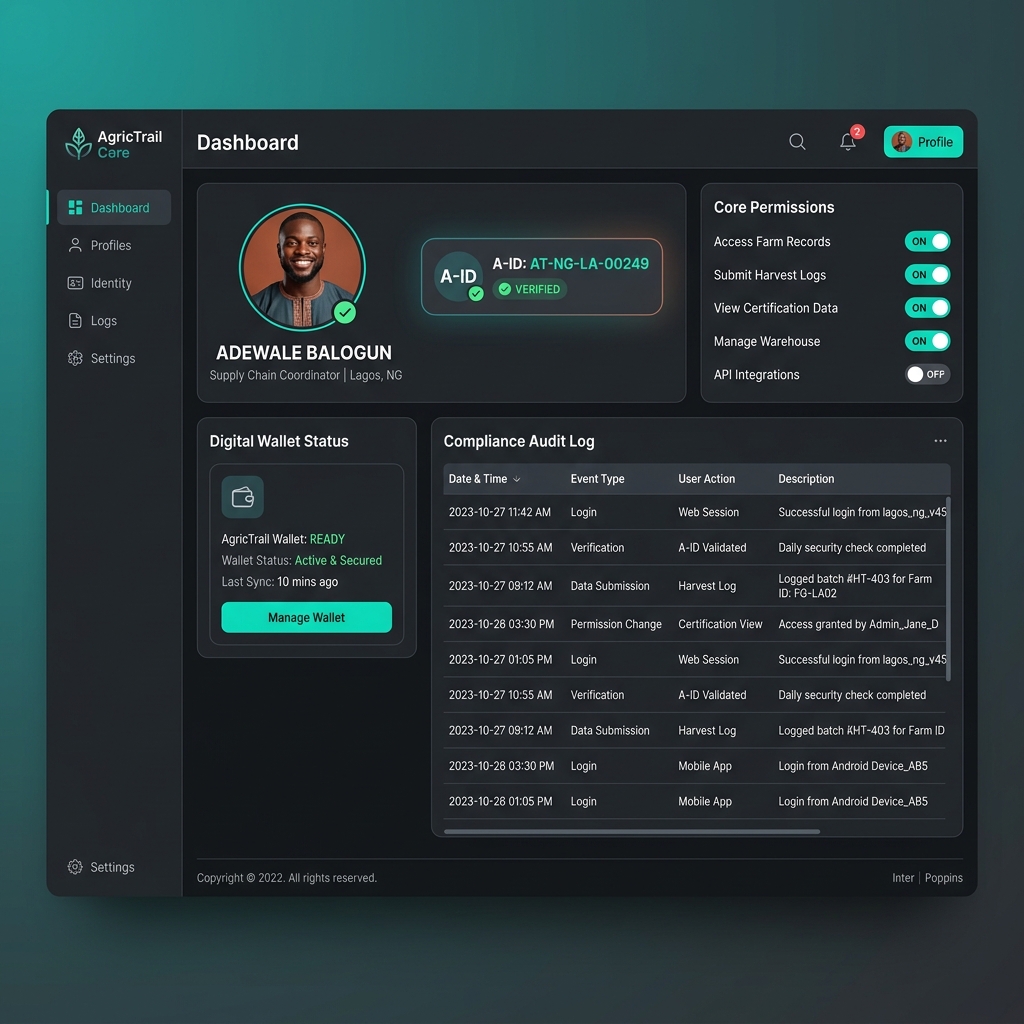
A-ID is AgricTrail's digital agricultural identity system.
It gives farmers, cooperatives, agribusinesses, service providers, and other agricultural ecosystem actors a unique identity within the AgricTrail platform. This identity can be linked to farm records, cooperative membership, production activities, transactions, services, training, traceability, and impact data.
For farmers, A-ID is more than a registration number.
It is a digital entry point into the agricultural economy.
It helps a farmer become visible, verifiable, and connected.
Why Farmer Visibility Matters
Visibility is one of the first steps toward inclusion.
When farmers are invisible, it is difficult for institutions to know who they are, where they are, what they produce, what support they need, what markets they serve, and what financial products may be suitable for them.
This creates a gap between farmers and opportunity.
Many farmers are excluded not because they are not working, but because their work is not properly captured in a trusted system. Their production history is not documented. Their sales are not recorded. Their cooperative participation is not visible. Their farm location may not be verified. Their identity may not be linked to their agricultural activity.
A-ID helps close this gap by giving each farmer a recognizable identity that can be connected to real farm and market records.
From Identity to Trust
Trust is essential in agriculture.
Buyers want to trust the source of produce. Cooperatives want to trust member records. Financial institutions want to trust borrower information. Governments want to trust beneficiary data. NGOs want to trust impact reporting. Consumers want to trust food origin.
A-ID helps build this trust by linking people, farms, cooperatives, and transactions into one structured identity layer.
When a farmer has an A-ID, their agricultural activities can gradually form a trusted profile. This profile can show who the farmer is, what they produce, where they operate, which cooperative they belong to, what farm records they have, what transactions they have completed, and what support they have received.
Over time, this creates a stronger evidence base for trade, finance, insurance, traceability, and development support.
A-ID and FarmMate
A-ID becomes more powerful when connected to FarmMate, AgricTrail's farm operating tool.
FarmMate helps farmers record farm activities such as enterprise type, production units, input use, labour, inventory, expenses, sales, and farm performance. When these records are connected to A-ID, the farmer's activity becomes part of a structured digital agricultural profile.
This matters because finance and market access depend on evidence.
A farmer's identity alone is not enough. A farmer also needs records that show activity, capacity, discipline, and growth potential.
With A-ID and FarmMate together, farmers can move from informal visibility to data-backed credibility.
A-ID and Cooperative Validation
Cooperatives play a major role in farmer visibility.
Many farmers are already organized through community-based groups, associations, and cooperatives. These structures can help verify members, coordinate production, aggregate produce, support training, and build trust.
A-ID allows farmer identity to be linked to cooperative membership.
This means a cooperative can know who its members are, what farms they operate, what they produce, and how they participate in cooperative activities. It also helps reduce duplication, ghost beneficiaries, and weak recordkeeping.
For financial institutions, buyers, governments, and NGOs, cooperative validation adds another layer of trust. A farmer is no longer just an isolated individual. The farmer becomes part of an organized economic structure with verifiable participation.
A-ID and Financial Inclusion
Financial inclusion begins when farmers can be seen, understood, and assessed fairly.
Many farmers are excluded from finance because they lack formal records, collateral, bankable profiles, or transaction history. Financial institutions may not have enough data to assess their repayment capacity or production risk.
A-ID helps create a pathway toward financial inclusion by connecting identity with agricultural activity.
Through A-ID, a farmer's profile can be linked to farm records, cooperative validation, production history, market participation, sales records, training, service usage, and repayment behaviour where applicable.
This can support credit readiness, input financing, insurance eligibility, savings products, cooperative lending, offtake-linked finance, and other agricultural financial services.
The goal is not to make finance automatic. The goal is to make farmers more visible and finance providers better informed.
Reducing Risk for Finance Providers
Agricultural finance is often seen as risky. Some of this risk is real, but some of it comes from poor information.
Without reliable data, finance providers may not know which farmers are active, what they produce, when they generate income, what their costs are, what markets they serve, or whether they belong to a trusted cooperative.
A-ID helps reduce information gaps.
When identity, farm records, transactions, and cooperative validation are connected, finance providers can make better decisions. They can design products around real production cycles. They can assess farmer readiness more accurately. They can work through cooperatives and structured value chains. They can monitor activity with better visibility.
This can help move agricultural finance from assumption-based lending to evidence-informed financing.
Supporting Input Credit and Production Finance
One important use of A-ID is input financing.
Many farmers need seeds, feeds, fertilizers, fingerlings, chicks, veterinary products, equipment, and other inputs before they can produce. But input suppliers and finance providers often hesitate because they cannot easily verify the farmer, track usage, or link financing to production and repayment.
With A-ID, farmers can be identified and linked to their farm records, cooperative membership, input requests, production plans, and market opportunities.
This creates a stronger structure for input credit, seasonal production finance, and cooperative-backed financing.
A farmer's identity becomes connected to the full production journey, from planning to input access, production, aggregation, sale, and repayment.
Supporting Insurance and Risk Protection
Farmers face many risks, including weather, disease, pests, price changes, mortality, flooding, drought, and logistics disruptions. Insurance can help protect farmers, but insurance providers need reliable data to design and deliver suitable products.
A-ID can support agricultural insurance by helping link farmers to location, enterprise type, production records, farm size, cooperative membership, and risk history.
This can make it easier to identify eligible farmers, structure insurance products, verify claims, and understand exposure across regions and value chains.
In this way, farmer identity becomes part of a wider risk protection system.
A-ID and Market Access
A-ID also supports better market access.
Buyers want to know who they are buying from. Processors want reliable suppliers. Exporters need traceability. Retailers need quality assurance. Consumers increasingly want confidence in food origin.
When farmers and cooperatives are identified through A-ID, market participation becomes more structured.
Produce can be linked to farmer identity, farm location, cooperative aggregation, quality records, and transaction history. This improves transparency and helps farmers participate in stronger markets.
A-ID helps farmers move from anonymous sellers to recognized participants in the value chain.
Preventing Exclusion and Duplication
Many agricultural programs struggle with poor beneficiary records, duplicate registration, weak verification, and limited follow-up data.
A-ID helps create a more organized system.
By giving each farmer a unique agricultural identity within AgricTrail, programs can better identify participants, avoid duplication, track support, monitor outcomes, and measure impact.
This is important for government programs, donor projects, cooperative schemes, input distribution, training programs, and financial inclusion initiatives.
When the right farmers are identified and properly supported, agricultural programs become more effective and accountable.
Data Ownership, Responsibility, and Trust
Farmer data must be handled responsibly.
A-ID is not about taking control away from farmers. It is about helping farmers build a trusted profile that serves their interests. Data should support access, opportunity, transparency, and inclusion.
AgricTrail's approach is to make farmer identity useful for practical outcomes: better records, better services, better market access, better finance readiness, better cooperative coordination, and better impact measurement.
Trust must remain at the centre of digital agriculture.
Farmers should know that their data is being used to help them become more visible, not to exploit them.
A Foundation for Africa's Agricultural Operating System
A-ID is one of the core foundations of AgricTrail's agricultural operating system.
Without identity, records are scattered.
Without records, trust is weak.
Without trust, finance is limited.
Without finance, growth becomes difficult.
By connecting identity with farm data, cooperative validation, trade records, finance readiness, services, traceability, and impact intelligence, A-ID helps create a stronger digital backbone for African agriculture.
It allows farmers to be seen. It allows institutions to engage better. It allows the agricultural ecosystem to work with clearer information.
Conclusion
A-ID matters because visibility matters.
A farmer cannot fully access the formal agricultural economy if the system cannot clearly identify, verify, and understand their activity.
AgricTrail ID helps farmers move from invisibility to recognition, from informal activity to structured records, from scattered participation to connected opportunity, and from exclusion to financial inclusion.
It is not just a number.
It is a pathway to trust, finance, markets, insurance, services, and long-term agricultural growth.
At AgricTrail, we believe every farmer deserves to be seen, supported, connected, and empowered.
That is why A-ID is central to our mission of building Africa's connected agricultural operating system.
AgricTrail — Connect. Grow. Sustain.