
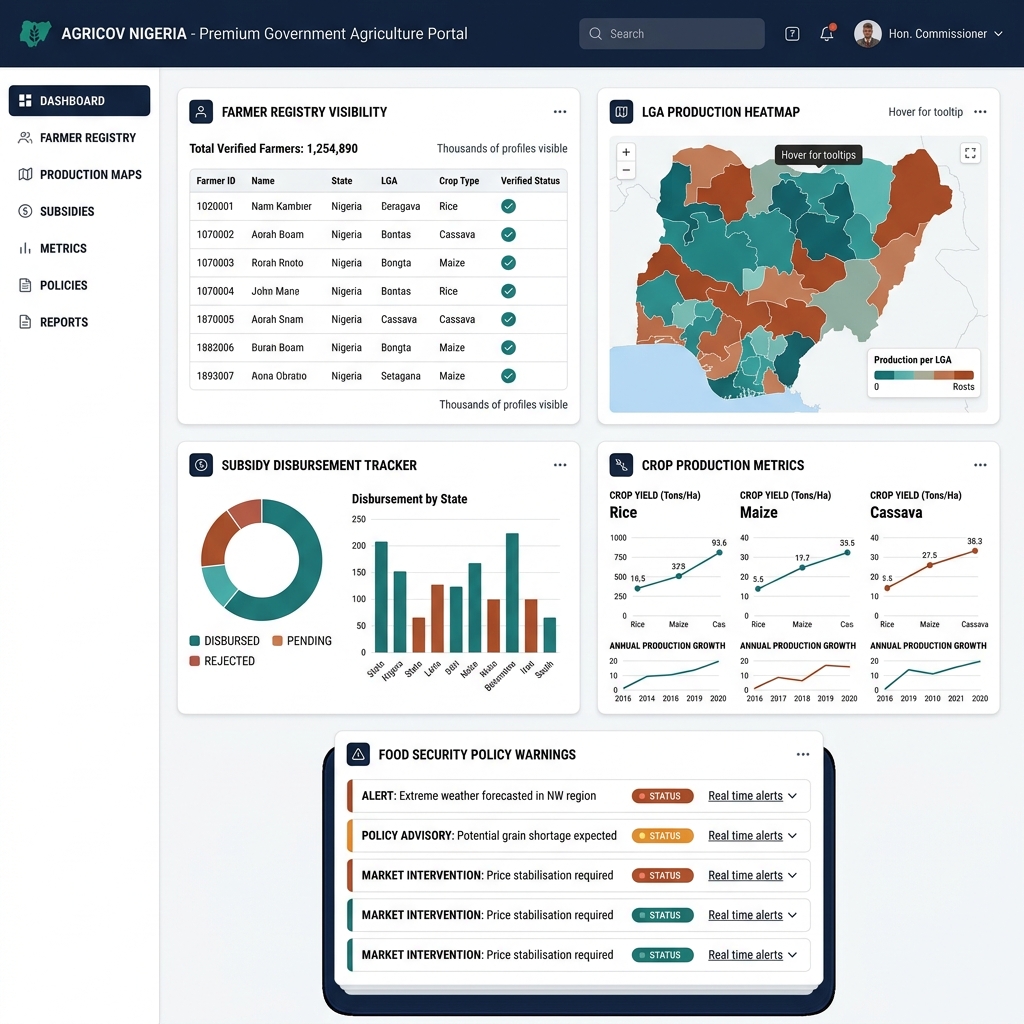
Agriculture is one of the most important sectors for Africa's food security, employment, rural development, trade, and economic growth. Yet many governments still make agricultural decisions with incomplete, outdated, or fragmented information.
In many cases, government agencies do not have real-time visibility into who is farming, what is being produced, where production is happening, what inputs are needed, where losses are occurring, which cooperatives are active, or which communities require urgent support.
This makes agricultural planning difficult.
Without reliable data, governments may distribute inputs without knowing the real demand. They may support farmers without accurate beneficiary records. They may plan food security interventions without clear production intelligence. They may invest in infrastructure without understanding where the strongest agricultural activity is happening.
Real-time agricultural data can change this.
It can help governments move from reactive decision-making to evidence-based agricultural planning.
The Problem With Outdated Agricultural Information
Many agricultural systems still depend on manual surveys, paper records, delayed reports, and fragmented databases. While these methods can provide useful information, they are often too slow to support urgent decisions.
Agriculture moves quickly.
Planting seasons change. Weather affects production. Disease outbreaks can spread. Market prices move. Input demand rises. Logistics challenges emerge. Farmers need timely support. Food shortages can develop before official reports are completed.
When governments rely only on delayed data, they may respond after the problem has already grown.
Real-time data helps close this gap. It gives government agencies a clearer view of what is happening across farms, cooperatives, markets, value chains, and regions.
Seeing Farmers Clearly
One of the most important uses of real-time agricultural data is farmer visibility.
Governments need to know who farmers are, where they are located, what they produce, what scale they operate, which cooperatives they belong to, and what support they need.
Without this visibility, agricultural programs can suffer from duplication, poor targeting, ghost beneficiaries, weak monitoring, and limited accountability.
Through digital identity systems such as AgricTrail ID, known as A-ID, farmers can become more visible within a structured agricultural ecosystem. Their identity can be connected to farm records, cooperative membership, production activities, training participation, input access, and market engagement.
This helps governments support real farmers with better accuracy.
Improving Input Distribution
Input distribution is one of the most common areas where agricultural data matters.
Governments often provide or support access to seeds, fertilizer, feeds, fingerlings, chicks, veterinary products, equipment, and other agricultural inputs. But without accurate data, inputs may not reach the right farmers at the right time.
Real-time data can help governments understand:
- Which farmers need inputs
- What type of inputs are needed
- Where demand is highest
- Which cooperatives can coordinate distribution
- Which farmers have received support
- Whether inputs were redeemed and used
- What production outcomes followed
This creates a more transparent and accountable input support system. Instead of distributing inputs blindly, governments can support farmers based on verified identity, farm profile, enterprise type, production plan, and location.
Strengthening Food Security Planning
Food security requires more than national production estimates.
Governments need timely intelligence on local production, crop performance, livestock activity, aquaculture output, market supply, storage capacity, aggregation volumes, and regional food movement.
Real-time agricultural data can help answer important questions:
- Which areas are producing enough food?
- Which areas may face shortages?
- Which value chains are under pressure?
- Which cooperatives have available supply?
- Where are post-harvest losses increasing?
- Which markets are experiencing supply gaps?
- Where should emergency support be directed?
This kind of intelligence helps governments plan better, respond faster, and reduce food system shocks.
Supporting Better Agricultural Policy
Good policy depends on good data.
When governments have access to real-time agricultural intelligence, they can design policies that reflect actual conditions on the ground.
For example, data can show which crops are expanding, which regions need irrigation support, which farmer groups require finance, which value chains need storage, which areas have logistics gaps, and which interventions are creating measurable impact.
This helps government move away from broad assumptions and toward targeted agricultural development.
Policy becomes more practical when it is based on real farmer activity, real production data, and real market behavior.
Monitoring Government and Donor Programs
Many agricultural programs are launched with good intentions, but monitoring outcomes can be difficult.
Governments and development partners need to know whether support reached the intended beneficiaries, whether farmers used the support properly, whether productivity improved, whether incomes increased, and whether the program created real impact.
Real-time agricultural data makes monitoring easier.
A program can track farmer onboarding, input distribution, training attendance, farm activity, production outcomes, market participation, and beneficiary progress.
This improves transparency. It also helps governments and donors identify what is working, what is not working, and where adjustments are needed.
Reducing Waste and Leakages
Agricultural support programs can suffer from leakages when records are weak.
Inputs may be diverted. Beneficiary lists may be duplicated. Farmers may be registered multiple times. Support may fail to reach the intended communities. Reports may not match actual field activity.
Digital agricultural data can reduce these problems.
When identity, location, farm profile, cooperative validation, input redemption, transaction records, and impact reporting are connected, it becomes harder for support systems to be abused.
Governments can track the movement of resources from allocation to delivery and from delivery to outcome. This improves accountability and public trust.
Planning Infrastructure Investment
Agriculture needs physical infrastructure.
Farmers need roads, storage, aggregation centres, cold rooms, processing facilities, laboratories, irrigation systems, water facilities, energy access, and logistics hubs.
But governments need data to know where these investments will have the greatest impact.
Real-time agricultural data can help identify high-production areas, underserved farming clusters, active cooperatives, major aggregation points, post-harvest loss zones, market corridors, and regions with strong value-chain potential.
This helps governments invest in infrastructure based on evidence.
For AgricTrail, this is where digital data connects with physical Trade Centres. A government can use agricultural intelligence to identify where Trade Centres, storage facilities, processing hubs, and logistics systems are most needed.
Supporting Cooperative Development
Cooperatives are essential to agricultural transformation.
Governments can use real-time data to understand which cooperatives are active, how many farmers they serve, what value chains they support, what volumes they aggregate, what services they need, and how they contribute to local food systems.
This allows government agencies to strengthen cooperatives as economic platforms.
With better data, cooperatives can be supported with training, finance, governance tools, input programs, aggregation infrastructure, and market linkage.
A cooperative that is visible and data-enabled can become a reliable channel for government intervention, farmer support, and rural development.
Improving Agricultural Finance and Insurance
Governments often want to expand agricultural finance, but financial institutions need reliable data to assess risk.
Real-time agricultural data can help bridge the gap between farmers and finance providers.
When farmer identity, farm records, production history, cooperative validation, market participation, and transaction data are available, financial institutions can make better decisions.
Governments can use this data to support credit guarantee programs, input finance schemes, insurance programs, cooperative lending, and climate-risk support.
Instead of treating agriculture as one large risk category, data allows finance to be better targeted and better structured.
Responding to Climate and Production Risks
Climate change is making agriculture more uncertain.
Farmers face flooding, drought, heat stress, changing rainfall patterns, pests, diseases, and other shocks. Governments need better tools to detect risks early and respond quickly.
Real-time agricultural data can support early warning systems by showing changes in production activity, crop performance, livestock health, water availability, market supply, and farmer needs.
When combined with weather data, satellite intelligence, and field reports, digital agricultural records can help governments prepare for risks before they become crises.
This is critical for protecting farmers, food supply, and rural livelihoods.
Improving Market Intelligence
Governments also need better visibility into agricultural markets.
Real-time data can show what commodities are available, where prices are changing, which markets are under-supplied, where aggregation is happening, and which value chains have trade potential.
This information can help governments support market stability, reduce price shocks, improve logistics planning, and connect surplus regions to deficit regions.
It can also help governments support export readiness by identifying value chains with strong production capacity, traceability potential, and buyer demand.
Building Public Trust Through Transparency
Citizens want to know that agricultural programs are fair, effective, and impactful.
Real-time data can help governments show progress more clearly.
Dashboards, reports, maps, and impact indicators can show how many farmers were supported, where support was delivered, what outcomes were achieved, and what gaps still exist.
This improves transparency and builds public trust.
It also helps policymakers, development partners, investors, and communities work with a shared understanding of agricultural progress.
The Role of AgricTrail
AgricTrail is building digital infrastructure that can help governments see agriculture more clearly.
Through AgricTrail ID, FarmMate, cooperative systems, Trade Centres, marketplace activity, traceability tools, and baseline and impact intelligence, AgricTrail can support government planning, monitoring, food security coordination, program delivery, and policy design.
The goal is not simply to collect data. The goal is to turn agricultural activity into intelligence that helps governments make better decisions and deliver better outcomes.
With real-time agricultural data, governments can support farmers more accurately, strengthen cooperatives, improve food security, attract investment, reduce waste, and build more resilient agricultural systems.
Conclusion
Governments cannot transform agriculture effectively without visibility.
They need to know who farmers are. They need to know what is being produced. They need to know where support is needed. They need to know which programs are working. They need to know where infrastructure should be built. They need to know how food is moving through the system.
Real-time agricultural data gives governments the intelligence they need to plan, act, monitor, and improve.
For Africa's food system to become stronger, public decision-making must be powered by trusted agricultural data.
That is why AgricTrail is building the digital backbone that connects farmers, cooperatives, markets, finance, traceability, infrastructure, and impact intelligence.
Because when governments can see agriculture clearly, they can support it more effectively.
AgricTrail — Connect. Grow. Sustain.