
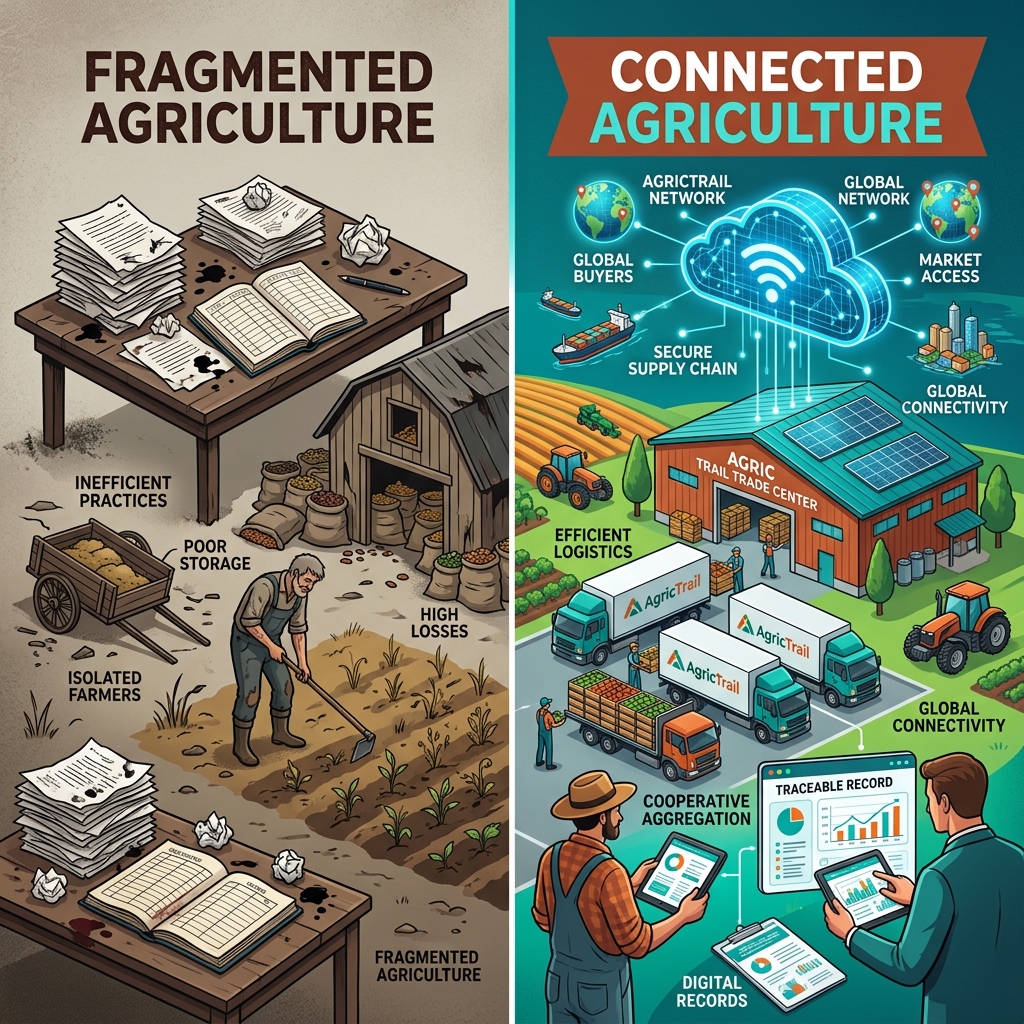
For years, agricultural transformation efforts have focused on one side of the equation.
Some initiatives have focused heavily on digital technology — building apps, marketplaces, databases, and online services. Others have focused primarily on physical infrastructure such as markets, warehouses, processing facilities, and aggregation centres.
Both approaches have created value.
But neither is sufficient on its own.
Agriculture is unique because it exists in both the digital and physical worlds. Farmers produce physical goods. Inputs must be delivered. Produce must be aggregated. Products must be stored, processed, transported, financed, and sold. Yet all of these activities also depend on information, coordination, identity, records, transactions, market intelligence, and data.
The future of African agriculture will not be built by digital platforms alone or physical infrastructure alone.
It will be built by connecting both.
This is the philosophy behind AgricTrail.
We believe agriculture needs a digital operating system supported by physical trade infrastructure that works together as one connected ecosystem.
The Limitation of Digital-Only Agriculture
Digital platforms have transformed many industries by improving access to information, communication, and transactions.
In agriculture, digital tools can help farmers manage records, access advisory services, connect to markets, apply for finance, join cooperatives, and receive training.
These are important capabilities.
However, agriculture ultimately produces physical products.
A farmer cannot upload a bag of maize to the internet. A fish farmer cannot deliver harvested fish through a mobile app. A cooperative cannot aggregate produce in a virtual warehouse. A processor cannot receive raw materials through a digital dashboard alone.
Even the best digital marketplace becomes limited if there is no reliable aggregation, storage, logistics, quality control, or processing infrastructure behind it.
Digital platforms can create visibility and coordination, but physical infrastructure is needed to move products through the value chain.
The Limitation of Physical-Only Agriculture
The opposite challenge also exists.
Many agricultural projects invest in warehouses, processing facilities, markets, cold rooms, training centres, and logistics assets without building strong digital systems around them.
As a result, infrastructure often operates below capacity.
Farmers are not properly identified. Supply forecasts are weak. Buyer demand is not visible. Inventory records are incomplete. Financial data is missing. Traceability is difficult. Impact measurement becomes unreliable.
Without digital systems, physical infrastructure can become disconnected from the information needed to operate efficiently.
A warehouse without visibility into production data cannot plan effectively. A processing facility without reliable supplier information may face supply shortages. A market without trusted records may struggle to attract institutional buyers.
Physical infrastructure becomes more powerful when supported by digital intelligence.
Agriculture Is a Coordination Challenge
Many agricultural problems are often described as production problems.
In reality, they are frequently coordination problems.
Farmers need inputs before production. Buyers need visibility before harvest. Logistics providers need demand forecasts. Financial institutions need trusted data. Processors need reliable supply. Governments need production intelligence. Cooperatives need member coordination. Consumers need traceability.
None of these challenges can be solved by physical infrastructure alone or digital systems alone.
They require both.
Digital platforms help coordinate information. Physical hubs help coordinate products. Together, they create functioning agricultural ecosystems.
The Digital Layer: Visibility, Intelligence, and Coordination
A strong digital platform creates visibility.
It helps identify farmers, cooperatives, agribusinesses, service providers, buyers, and other ecosystem participants. It captures records, transactions, production data, market activity, and performance indicators.
Digital systems help answer important questions:
- Who is producing?
- What is being produced?
- Where is production happening?
- What services are needed?
- What markets are available?
- What volumes are expected?
- What support should be provided?
- What impact is being created?
These insights improve planning, decision-making, and coordination across the value chain.
This is why AgricTrail is building a connected agricultural operating system that links identity, production, trade, finance, traceability, services, and impact intelligence.
The Physical Layer: Movement, Storage, and Value Creation
Agriculture also requires physical coordination.
Produce must be aggregated. Inputs must be distributed. Products must be stored. Quality must be verified. Goods must be processed. Deliveries must be coordinated. Markets must be supplied.
These activities require physical infrastructure.
Without aggregation centres, farmers struggle to achieve scale. Without storage, post-harvest losses increase. Without processing facilities, value addition remains limited. Without logistics infrastructure, market access becomes difficult.
Physical hubs help solve these challenges by providing locations where agricultural activity can be organized and supported.
Why Farmers Need Both
A farmer needs more than a mobile application.
The farmer also needs access to inputs, storage, buyers, finance, training, logistics, and processing opportunities.
Likewise, a farmer needs more than a warehouse or market building.
The farmer also needs visibility, records, digital identity, market information, transaction history, and access to services.
The most successful agricultural systems connect both worlds.
A farmer should be able to record production digitally while accessing physical services locally. A cooperative should be able to coordinate members digitally while aggregating produce physically. A buyer should be able to source digitally while collecting products through structured physical locations. A lender should be able to assess digital records while financing real-world agricultural activity.
How AgricTrail Combines Both
AgricTrail is designed around the belief that digital and physical infrastructure must work together.
The digital layer includes:
- AgricTrail ID (A-ID)
- FarmMate farm management tools
- Cooperative management systems
- Marketplace and trade infrastructure
- Financial readiness and credit intelligence
- Traceability systems
- Impact and agricultural intelligence
The physical layer includes AgricTrail Trade Centres. These Trade Centres are designed to provide aggregation, storage, cold chain facilities, mini-processing, input access, quality control, training, logistics coordination, laboratory services, and market linkage.
Together, they create a complete ecosystem.
The platform generates visibility and coordination. The Trade Centre provides execution and physical support.
The Journey from Farm to Market
Consider a farmer producing tomatoes.
Through the digital platform, the farmer receives an A-ID, records farm activities in FarmMate, joins a cooperative, accesses advisory support, and receives market information.
When harvest arrives, the farmer delivers produce to the AgricTrail Trade Centre.
At the centre, the tomatoes are aggregated, graded, recorded, stored, and linked to buyers. Logistics are coordinated. Transactions are captured digitally. Traceability records are maintained. Payments can be processed through structured channels.
Without the digital layer, coordination would be weak. Without the physical hub, execution would be difficult. Together, they create an efficient pathway from production to market.
Supporting Finance Through Connected Infrastructure
Financial inclusion becomes stronger when digital and physical systems work together.
Digital records help demonstrate production history, transaction activity, cooperative participation, and market engagement.
Physical hubs help verify inventory, aggregation volumes, storage activity, and product movement.
Together, they provide stronger evidence for financial institutions. This can support:
- Input financing
- Working capital
- Cooperative lending
- Warehouse receipt finance
- Trade finance
- Agricultural insurance
Finance becomes easier when both information and physical assets are visible.
Building Trust Across the Food System
Trust is essential for agricultural growth.
Buyers need trusted suppliers. Farmers need trusted markets. Lenders need trusted data. Governments need trusted records. Consumers need trusted food sources.
Digital systems help create transparency. Physical hubs help create accountability. Together, they strengthen trust throughout the food system.
This trust supports trade, investment, partnerships, compliance, and long-term growth.
Creating Stronger Rural Economies
When digital and physical infrastructure are combined, local communities benefit.
Farmers gain better market access. Cooperatives become stronger. Youth employment opportunities increase. Agribusinesses operate more efficiently. Financial services become more accessible. Post-harvest losses decline. More value is retained locally.
Trade Centres can become economic hubs while the digital platform connects those hubs into a larger agricultural network.
This creates a stronger foundation for rural prosperity.
The Future of Agricultural Development
The next generation of agricultural development will not be built around isolated projects.
It will be built around connected ecosystems.
Digital platforms will provide identity, data, intelligence, coordination, and transparency. Physical hubs will provide aggregation, storage, processing, logistics, and service delivery. Together, they will create resilient agricultural systems capable of supporting farmers, cooperatives, agribusinesses, governments, financiers, and consumers.
The most successful agricultural economies will be those that integrate both.
Conclusion
Agriculture needs both digital platforms and physical hubs because food systems operate in both the information economy and the real economy.
Digital tools create visibility, intelligence, and coordination. Physical infrastructure enables aggregation, storage, processing, logistics, and market access. Neither can achieve its full potential without the other.
At AgricTrail, we are building an agricultural operating system that combines the power of digital infrastructure with the practical impact of physical Trade Centres.
Because transforming African agriculture requires more than technology.
It requires connected systems that help people, products, services, finance, and information move together.
That is how farmers prosper.
That is how markets grow.
That is how food systems become stronger.
AgricTrail — Connect. Grow. Sustain.