
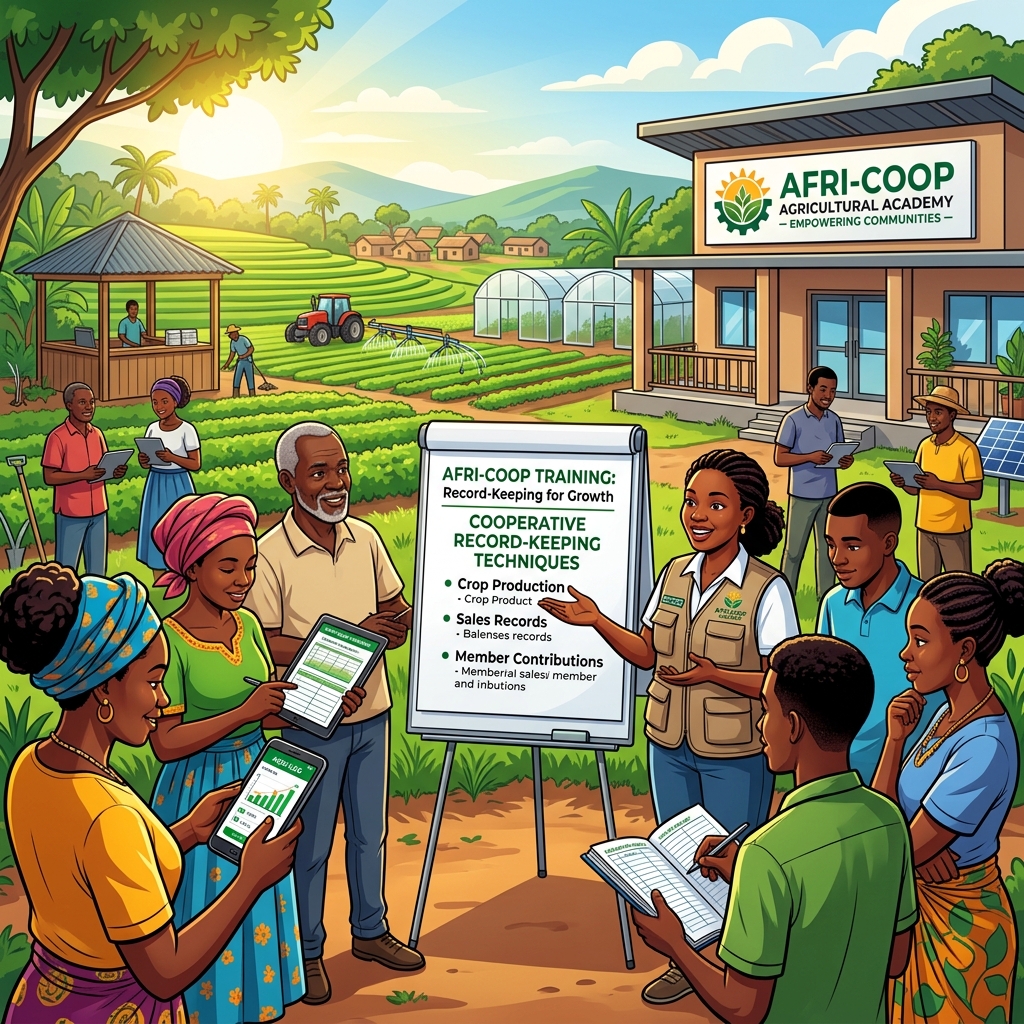
Africa's food system depends on millions of farmers who work daily to produce crops, raise livestock, manage fish farms, supply local markets, and feed communities. Yet many of these farmers operate in fragmented, informal, and under-supported environments.
Individually, many farmers face the same barriers: limited access to finance, weak bargaining power, poor market visibility, high input costs, low productivity support, logistics challenges, and lack of structured data.
But when farmers are organized, their strength multiplies.
This is why cooperatives remain one of the most important foundations for transforming agriculture in Africa. Cooperatives are not just farmer associations. They are community-based economic structures that can organize production, aggregate demand, coordinate supply, improve access to finance, strengthen market participation, and create pathways for inclusive growth.
At AgricTrail, we believe cooperatives are the backbone of Africa's food system because they connect individual farmers to the wider agricultural economy.
The Power of Collective Organization
A single farmer may struggle to negotiate with input suppliers, buyers, banks, processors, exporters, and government programs. But when farmers come together under a cooperative, they can create scale, visibility, and stronger bargaining power.
Cooperatives help farmers move from isolation to coordination.
Through cooperatives, farmers can buy inputs in bulk, access training, share services, aggregate produce, negotiate better prices, reduce transaction costs, and participate in larger market opportunities.
This collective structure is especially important in Africa, where many farmers operate at small or medium scale and need organized support to compete in formal markets.
Cooperatives Create Market Access
One of the biggest challenges farmers face is not only production. It is selling at the right price, to the right buyer, at the right time.
Many farmers produce without reliable access to structured markets. As a result, they may sell under pressure, accept low prices, or lose value because of poor storage, weak logistics, or limited buyer connections.
Cooperatives help solve this problem by aggregating produce and linking farmers to buyers, processors, traders, exporters, and institutional markets.
When cooperatives are properly structured, they can help farmers meet volume requirements, improve quality standards, coordinate delivery, and negotiate from a position of strength.
This is how farmers move from scattered selling to organized trade.
Cooperatives Strengthen Food Security
Food security is not only about producing more food. It is also about ensuring that food moves efficiently from farms to markets, communities, processors, and consumers.
Cooperatives play a critical role in this process.
They help organize farmers at the local level. They support production planning. They coordinate aggregation. They reduce gaps between farmers and buyers. They help identify where support is needed. They can also serve as trusted channels for agricultural programs, training, inputs, mechanization, and emergency response.
When cooperatives are strong, food systems become more resilient.
They make it easier to know who is producing, what is being produced, where production is happening, and how farmers can be supported to increase output and reduce losses.
Cooperatives Improve Access to Finance
Finance remains one of the biggest barriers in African agriculture.
Many farmers cannot access loans, insurance, input credit, or working capital because they lack collateral, formal records, verifiable transactions, or strong financial profiles.
Cooperatives can help bridge this gap.
Through cooperatives, farmers can build shared credibility. Cooperative records can support member validation, production planning, repayment coordination, savings structures, input financing, and group-based lending.
A bank may find it difficult to assess thousands of individual farmers separately. But a structured cooperative with verified members, production data, transaction records, and governance systems can become a stronger channel for agricultural finance.
This is why AgricTrail sees cooperatives as financial bridges between farmers and lenders, insurers, buyers, development partners, and input suppliers.
Cooperatives Support Better Data and Planning
Agriculture cannot be transformed without reliable data.
Governments, NGOs, investors, financial institutions, and buyers need accurate information to make better decisions. They need to know where farmers are, what they produce, what support they need, what markets they serve, and what impact is being created.
Cooperatives can become powerful data points in the food system.
With the right digital tools, cooperatives can help capture farmer identity, farm location, enterprise type, production capacity, input needs, training participation, aggregation volumes, sales records, and impact outcomes.
This makes agricultural planning more accurate.
Instead of guessing, decision-makers can work with real cooperative-level intelligence. This can improve food security planning, infrastructure investment, donor reporting, market development, credit assessment, and regional agricultural strategy.
Cooperatives Build Trust
Trust is essential in agriculture.
Farmers need to trust buyers. Buyers need to trust suppliers. Banks need to trust borrowers. Governments need to trust beneficiary data. Consumers need to trust food origin and quality.
Cooperatives sit at the centre of this trust system.
A well-managed cooperative can validate its members, coordinate standards, confirm production activity, support repayment discipline, and strengthen accountability across the value chain.
This trust becomes even more powerful when combined with digital identity, farm records, traceability, and verified transactions.
At AgricTrail, cooperative data can be linked to AgricTrail ID, farm records, aggregation history, production activities, and trade participation. This helps create a stronger evidence layer for markets, finance, insurance, traceability, and impact measurement.
Cooperatives Help Farmers Capture More Value
Too often, farmers do the hardest work but capture the least value.
They produce the food, but weak coordination leaves them exposed to poor pricing, post-harvest losses, limited processing access, and dependence on informal market channels.
Cooperatives can help farmers move up the value chain.
They can support aggregation, storage, grading, processing, packaging, branding, transport, and direct market linkage. They can also help farmers participate in input procurement, warehouse receipt systems, contract farming, export readiness, and commodity trade.
When cooperatives are supported with digital tools and physical infrastructure, they can become engines of rural economic development.
AgricTrail's Cooperative-Led Approach
AgricTrail is building a cooperative-led agricultural operating system because we believe transformation must start where farmers are already organized: in their communities.
Our platform supports cooperatives with digital identity, member onboarding, farmer verification, farm linkage, production tracking, aggregation, governance, marketplace participation, financial readiness, and impact reporting.
AgricTrail also supports a federation structure that can connect primary cooperatives to local, state, national, and continental agricultural systems.
This matters because African agriculture needs coordination from the village level to national food security planning, and from local aggregation to regional and export markets.
AgricTrail's cooperative infrastructure is designed to make that possible.
Digital Cooperatives for a Modern Food System
The future cooperative cannot remain only paper-based.
To serve farmers effectively in a modern food system, cooperatives need digital infrastructure. They need member records, farm data, transaction history, production intelligence, governance tools, market access, traceability support, and finance-readiness systems.
Digital cooperatives can help farmers become more visible, organized, and bankable.
They can help buyers source more reliably.
They can help governments and development partners plan better.
They can help financial institutions reduce risk.
They can help communities build stronger agricultural economies.
This is the kind of cooperative transformation AgricTrail is working to support.
Why This Matters Now
Africa's food demand is rising. Climate pressure is increasing. Youth unemployment remains a major challenge. Farmers need better income opportunities. Governments need stronger food security intelligence. Buyers need reliable supply. Financial institutions need better agricultural data.
No single farmer can solve these challenges alone.
But organized cooperatives, powered by digital infrastructure, can become the foundation for a stronger food system.
They can help connect farmers to finance, markets, services, data, and opportunity.
They can turn fragmented production into structured supply.
They can turn informal activity into visible economic value.
They can turn rural communities into engines of agricultural growth.
Conclusion
Cooperatives are the backbone of Africa's food system because they organize farmers, strengthen markets, improve access to finance, support food security, build trust, and create pathways for inclusive growth.
They are the bridge between individual farmers and the wider agricultural economy.
At AgricTrail, we are building technology that helps cooperatives become stronger, smarter, more transparent, and more economically powerful.
Because when cooperatives work better, farmers grow stronger.
When farmers grow stronger, food systems become more resilient.
And when Africa's food system becomes more resilient, communities prosper.
AgricTrail — Connect. Grow. Sustain.